
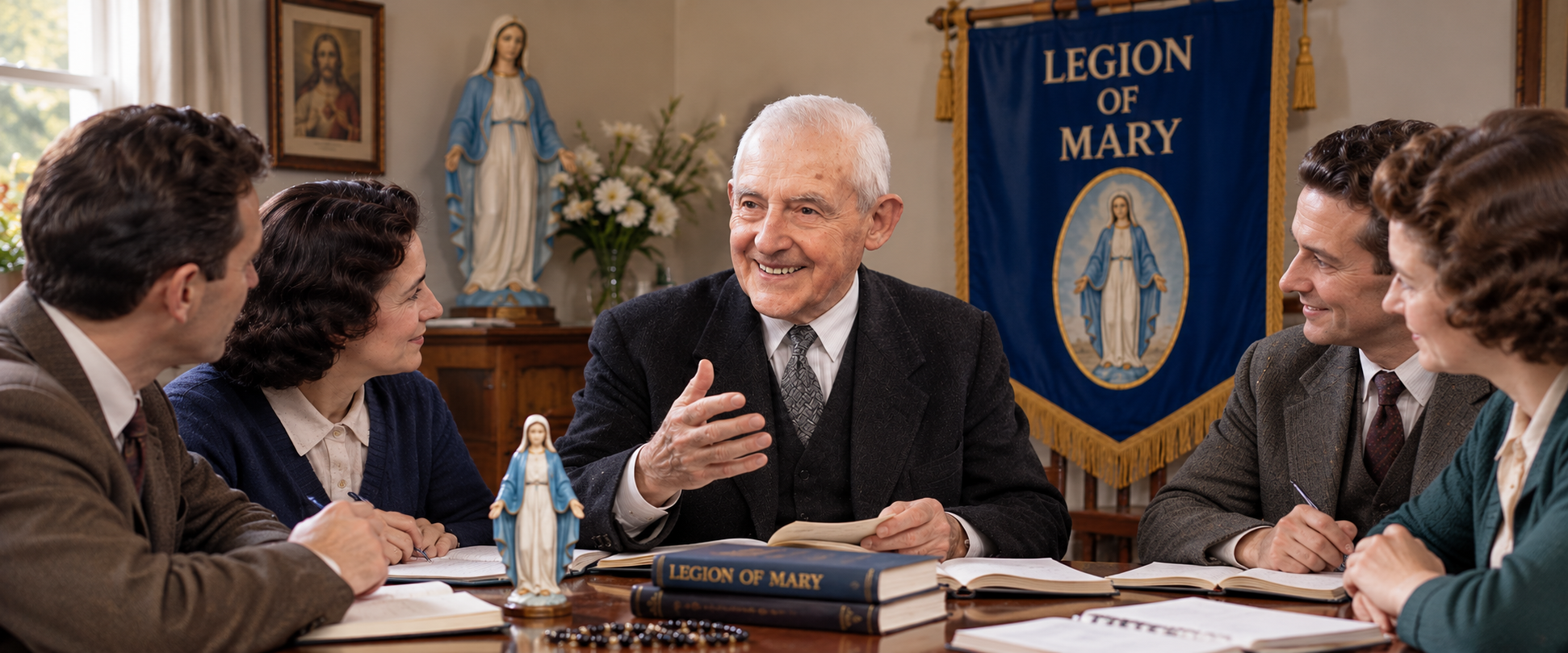
The Irish layman who founded the Legion of Mary and inspired generations of Catholics to share their faith.
On 7 September 1921, a small group of Catholics gathered in Dublin to pray and consider how they might serve others in the name of Christ. Led by a young civil servant named Frank Duff, they began an initiative that would eventually spread throughout the world. They could hardly have imagined the influence their meeting would have on the life of the Catholic Church.
Frank Duff was convinced that the Christian faith called for an active response. Prayer, personal holiness and practical service belonged together. He believed that ordinary Catholics, strengthened by the grace of God, could become effective instruments of Christ’s love in the world. His life offers a compelling example of what can happen when a Christian takes the Gospel seriously and allows it to shape everyday decisions.
A Growing Faith
Francis Michael Duff was born in Dublin on 7 June 1889. He was the eldest of seven children and received his education at Belvedere College and Blackrock College. At the age of eighteen, he entered the Irish Civil Service, beginning a career that might have led to a comfortable and conventional life.
His spiritual journey took a significant turn in 1913 when, aged twenty-four, he joined the Society of St Vincent de Paul. Through his involvement in visiting and assisting people experiencing poverty, he developed a deeper understanding of the practical demands of Christian charity. He began to recognise Christ in the people he encountered, particularly those who were poor, neglected or excluded from society. These experiences challenged him to look beyond the outward circumstances of people’s lives and consider their spiritual needs as well.
Duff’s faith increasingly shaped his daily routine. He developed a strong commitment to prayer and the celebration of the Eucharist. He also became convinced that holiness was not reserved for priests and religious. Every Christian was called to become a saint. In 1916, he published a pamphlet entitled Can We Be Saints? In it, he argued that holiness was a genuine possibility for ordinary Catholics. God had given his Church the spiritual resources necessary for people to grow in holiness, and Christians were called to make use of them.
This conviction would remain central to Duff’s life and work.
Discovering the Importance of Mary
In 1917, Duff encountered the writings of St Louis Marie de Montfort, particularly True Devotion to Mary. This book helped him develop a deeper understanding of Mary’s place in God’s plan of salvation and her relationship with the mission of Jesus Christ. His growing devotion to Mary was firmly centred on Christ. He understood that authentic Marian devotion should lead Christians into a closer relationship with Jesus and a more complete commitment to his mission. Mary’s response to God provided an example of faith, humility and obedience. Her words to the servants at the wedding feast of Cana, “Do whatever he tells you” (John 2:5), expressed something of the spiritual attitude Duff wanted to cultivate.
He believed that Christians who entrusted themselves to Mary would be encouraged to follow Christ more faithfully and to serve others with greater generosity. This Marian spirituality would become one of the defining characteristics of the organisation he founded.
The Birth of the Legion of Mary
On 7 September 1921, Frank Duff gathered with a group of Catholic women and Fr Michael Toher, a priest of the Archdiocese of Dublin, for the first meeting of what would become the Legion of Mary. The group met in Myra House on Francis Street in Dublin. Their purpose was straightforward: to pray together and undertake practical works of Christian service. The first members visited people who were sick in hospitals. Their activities subsequently extended to people experiencing poverty, isolation and other difficult circumstances. Duff wanted the group to do more than provide occasional charitable assistance. He hoped that its members would grow in holiness through prayer and active service, while helping others encounter the love of God.
The Legion’s spirituality brought together three essential elements:
Prayer. Members would deepen their relationship with God through the Eucharist, the Rosary and other forms of personal and communal prayer.
Personal holiness. Members would seek to become more faithful disciples of Jesus Christ, allowing their faith to influence their attitudes, relationships and decisions.
Active service. Members would undertake practical apostolic work, seeking opportunities to serve their neighbours and bring the Gospel into people’s lives.
These principles remain central to the Legion of Mary today.
From its modest beginnings in Dublin, the organisation spread throughout Ireland and then internationally. Duff devoted much of his life to guiding its development, helping establish a structure that enabled local groups to work together in prayer, formation and service. The Legion became one of the most widely established lay apostolic movements in the Catholic Church.
Bringing the Gospel to People on the Margins
One of the most striking aspects of Duff’s approach was his willingness to reach people whom others might overlook. He understood that Christian mission could not be confined to church buildings or to those who were already practising their faith. If the Gospel was to reach people, Christians needed to be willing to meet them where they were.
The early Legionaries undertook challenging forms of apostolic work in Dublin, including reaching out to women involved in prostitution in the city’s Monto district. They encountered people whose lives were marked by poverty, exploitation and social exclusion. Their approach combined practical assistance with a concern for the spiritual and personal well-being of those they met. They sought to treat each person with dignity and to offer hope where people had often experienced rejection.
This work reflected Duff’s conviction that every person matters to God. No one should be regarded as beyond the reach of divine mercy. His example also challenged Catholics to move beyond comfortable assumptions about who might be interested in the Christian faith. Sometimes the people who appear least likely to respond to the Gospel are those who most need someone to approach them with genuine care and respect. Duff did not believe that evangelisation was simply a matter of speaking to people about religion. It also required the patience to build relationships, the courage to enter unfamiliar situations and the willingness to accompany people as they faced difficult circumstances.
A Missionary Vision for Ordinary Catholics
Frank Duff’s vision was remarkable for its time. He believed that lay Catholics could take an active role in the Church’s apostolic mission, rather than leaving this work primarily to priests and religious. He did not see lay involvement as a substitute for the ministry of priests. The Legion operated under ecclesiastical guidance and worked in cooperation with the wider Church. Nevertheless, he recognised that lay people had opportunities to reach individuals and communities that clergy might find difficult to reach in their daily ministry.
A Catholic living in a neighbourhood, working in an office, studying at college or caring for a family encounters people and situations that provide natural opportunities for Christian witness. Duff believed that these everyday relationships could become places of service and evangelisation. This understanding would later find strong expression in the teaching of the Second Vatican Council, which emphasised the responsibility of the whole Church to participate in Christ’s mission.
In 1965, Duff attended the Council as a lay observer. He lived to see the Church give increasing attention to the dignity, responsibility and apostolic activity of lay Catholics. His life had already demonstrated what such participation could look like in practice. He had helped create a movement through which ordinary people could receive spiritual formation, undertake apostolic work and support one another in living their faith.
By the time the Second Vatican Council opened in 1962, Frank Duff had spent more than forty years developing a practical understanding of the role of lay Catholics in the mission of the Church. Through the Legion of Mary, he had demonstrated that ordinary Christians could be formed in their faith, grow in holiness and undertake organised apostolic work in their communities. In 1965, during the Council’s fourth and final session, Duff was invited to attend as a lay auditor. It was a significant recognition of his contribution to the Church and its apostolic mission.
When Archbishop John Heenan of Liverpool saw Duff arriving in the Council assembly, he drew attention to his presence. The assembled bishops responded with a standing ovation. It was a remarkable moment of recognition for a layman who had devoted his life to encouraging Catholics to take an active part in the Church’s mission.
Lessons from Frank Duff’s Life
Frank Duff’s example continues to offer valuable lessons for Catholics seeking to live their faith more fully.
1. Holiness is for everyone
Duff’s early pamphlet, Can We Be Saints?, expressed a conviction that shaped his entire life. Every Christian is called to holiness.
This does not mean that everyone must become a priest, enter religious life or undertake an extraordinary public ministry. Holiness begins in the ordinary circumstances of life, through faithfulness to God, love of neighbour and a willingness to respond to grace.
The question is not whether we have been given an unusual gift or a prominent position. It is whether we are willing to let God work through us.
2. Prayer and action belong together
Duff’s spirituality combined a strong life of prayer with practical service. He did not regard these as competing priorities.
Prayer helped members of the Legion grow in their relationship with God and prepare for their apostolic work. Their encounters with people, in turn, challenged them to become more compassionate and faithful disciples.
Christians today can easily become absorbed either in activity or in private spiritual concerns. Duff’s example reminds us that prayer should shape our actions, while our service should continually lead us back to God.
3. Every person deserves dignity and respect
Duff’s concern for people living on the margins of society challenged the prejudices and indifference of his time. His example encourages Christians to look beyond appearances and social labels. The person who is lonely, the neighbour experiencing difficulties, the individual who has drifted away from the Church and the person who seems uninterested in religion all deserve to be treated with dignity. We cannot know in advance what God may do in someone’s life through a simple act of kindness, a conversation or a willingness to listen.
4. Evangelisation begins with relationships
The Legion’s apostolic approach placed great importance on personal contact. Its members went out to meet people rather than waiting for everyone to come to them. This remains an important lesson for the Church. Evangelisation often begins with an ordinary conversation, a visit, a question or an expression of genuine interest in another person’s life. We do not need to have an answer to every question before we can begin. We need a willingness to listen, to share our faith honestly when appropriate and to trust that God is already at work in the lives of those we meet.
5. Mission requires formation and perseverance
Duff did not assume that good intentions were enough. The Legion developed a disciplined approach to prayer, formation and apostolic service. Its members learned through their spiritual life, their weekly meetings and their practical experiences of reaching out to others. The lesson is simple. If we want to serve Christ faithfully, we must continue to grow as disciples. We need to deepen our understanding of the faith, develop habits of prayer and learn from experience. Christian mission is a lifelong commitment.
A Legacy That Continues
Frank Duff died in Dublin on 7 November 1980, aged ninety-one. By then, the movement he had founded had spread around the world, with members serving in many different cultures and circumstances. His influence extended beyond the organisational growth of the Legion of Mary. He had demonstrated how a lay Catholic could combine a demanding working life with a deep commitment to prayer, personal holiness and apostolic service. The Church formally opened his cause for beatification in 1996. He is recognised as the Servant of God Frank Duff. His legacy is particularly visible in the continuing work of Legionaries who gather for prayer, receive formation and undertake apostolic activities in their local communities.
Yet his example speaks to Catholics beyond the Legion itself. You do not need to join a particular movement to learn from his life. You can begin by taking your own faith seriously, making time for prayer, noticing the needs of people around you and asking God how you might serve. Frank Duff believed that God could work through ordinary Catholics who were willing to respond generously. His life provides a practical demonstration of that conviction.
To find out more about the life of Frank Duff read Frank Duff: A Life Story by Finola Kennedy
Further reading: The official website of the Legion of Mary provides further information about Frank Duff’s life and his cause for beatification: Legion of Mary Ireland: Servant of God Frank Duff.

