
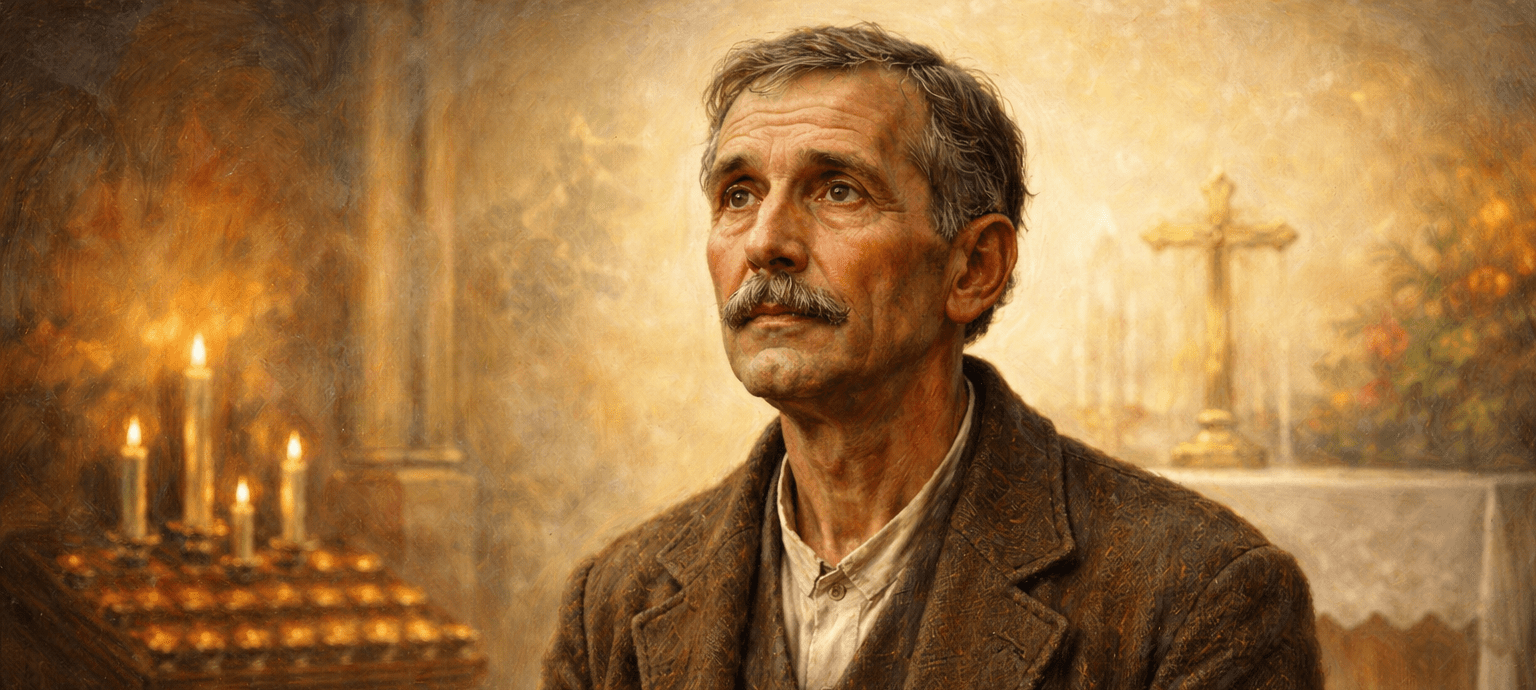
Holiness does not always look dramatic.
Sometimes it looks like a dock worker walking quietly to Mass before sunrise.
The life of Matt Talbot is one of the most powerful examples of the lay vocation lived in hidden fidelity. Long before the Second Vatican Council articulated the “Universal Call to Holiness,” Talbot was already living it. Irish bishops have often described him as a “layman ahead of his time.”And in many ways, he was.
From Addiction to Conversion
Born in Dublin in 1856, Talbot left school early and began working as a labourer. By his teens he was deeply addicted to alcohol. For nearly fifteen years, drink controlled his life. Then came a moment of humiliation and grace. Ignored by companions outside a public house, Talbot returned home and resolved to change. But he did not rely on determination alone.
He went to confession.
He sought spiritual direction.
He began attending daily Mass.
He took a pledge of abstinence — first temporary, then lifelong. His story reminds us of a foundational truth: vocation begins with conversion. Before mission comes surrender.
A Layman in the World
Talbot did not enter a monastery. He did not become a priest. He remained a dock worker.
Outwardly, his life appeared ordinary:
- manual labour,
- modest wages,
- a small rented room,
- a hidden routine of prayer.
But inwardly, his life was radically centred on God. He structured his entire day around the Eucharist. He practised fasting and self-denial. He gave generously — often secretly — to the poor. After his death in 1925, people began to realise that this quiet labourer had been living a deeply disciplined spiritual life. And then came two striking discoveries.
The Chains: Hidden Penance and Marian Devotion
When hospital staff prepared his body after his sudden death on Trinity Sunday, they discovered that Talbot had been wearing iron chains around his waist and arms beneath his clothing.
This was not self-punishment in a distorted sense. It was part of a traditional ascetical practice associated with the spirituality of Louis de Montfort, especially his teaching in True Devotion to Mary.
Talbot had studied de Montfort’s writings and embraced a deep Marian spirituality. The wearing of chains symbolised total consecration — a willing “bond of love” to Christ through Mary.
It was intense. It was hidden. And it was entirely unknown to most people around him.
He was not performing holiness.
He was pursuing it.
His penance was not about display but about discipline — especially in the context of his lifelong battle against addiction.
The Library: Intellectual Discipline in a Small Room
After his death, another discovery surprised those who knew him.
In his modest rented room, Talbot had assembled a substantial personal library of theology and spiritual classics.
For a man with very limited formal education, this was remarkable.
He read Scripture deeply.
He studied spiritual writers.
He immersed himself in Catholic teaching.
This was not casual devotion. It was intentional formation.
Talbot understood that growth in holiness required both prayer and intellectual discipline.
In a time when lay theological formation was uncommon, he pursued it seriously — decades before the Church would strongly emphasise lay formation in Christifideles Laici.
A Layman Ahead of His Time
At the Second Vatican Council, the Church formally proclaimed in Lumen Gentium that all the baptised are called to holiness.
This “Universal Call to Holiness” was revolutionary in language — but not in truth.
Matt Talbot had already been living it.
He showed that sanctity:
- is possible in manual labour,
- is possible in recovery from addiction,
- is possible without public ministry,
- is possible in hidden, faithful lay life.
He did not withdraw from the world.
He sanctified his place within it.
He is often cited as proof that the lay vocation is not secondary to priesthood or religious life — it is essential to the Church’s mission.
Why Matt Talbot Matters Today
His life speaks powerfully into modern struggles:
- addiction and recovery
- spiritual discipline
- hidden suffering
- lay formation
- Marian devotion
- Eucharistic centrality
He reminds us that holiness is not about platform or prestige.
It is about daily fidelity.
It is about surrender.
It is about allowing grace to reshape even the most wounded parts of our lives.
A dock worker became a spiritual giant — not because he changed his circumstances, but because he allowed Christ to change him.
For the Lay Faithful Today
Talbot’s life challenges every lay Catholic:
- Do I take my spiritual formation seriously?
- Is the Eucharist truly central in my life?
- Am I willing to embrace discipline for the sake of freedom?
- Do I believe holiness is possible in ordinary work?
The vocation of the laity is not an afterthought in the Church.
It is a frontline mission.
And Venerable Matt Talbot stands as a prophetic witness to that truth.


