
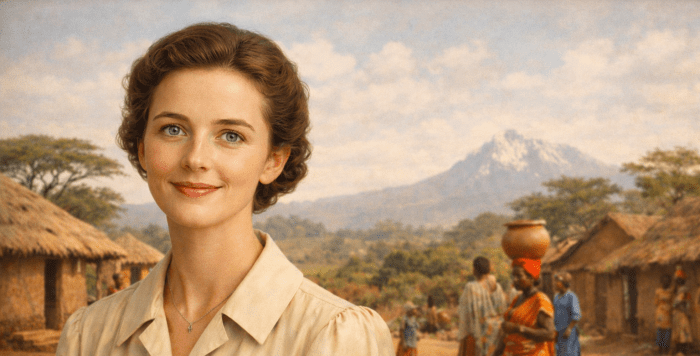
I was very fortunate recently to be given a battered copy of Edel Quinn’s biography, written in the 1950s by Cardinal Suenens. It’s a richly detailed portrait of a young missionary whose life proves just how powerful a lay vocation can be — one young woman, answering God’s call, reaching across the ocean to Africa and transforming the lives of thousands.
When we hear words like saint or missionary, most of us instinctively imagine someone who belongs to a very specific category:
A priest.
A nun.
A monk.
Someone “super holy”.
Someone who somehow has the courage and clarity we don’t.
But Edel Quinn breaks every stereotype.
She wasn’t a religious sister. She wasn’t a famous preacher. She wasn’t even physically strong.
She was a young Irish laywoman, full of life and personality, who lived with serious illness — and yet said “yes” to God with such courage that her life still echoes across Africa today.
And for young adults trying to work out what vocation really means, Edel Quinn might just be one of the most important role models you’ve never heard of.
A normal Irish girl… with an uncommon desire for God
Edel Quinn was born Edelweiss Mary Quinn on 14 September 1907 in Kanturk, County Cork, the eldest child of Charles Quinn (a bank official) and Louisa Burke Browne.
Her unusual first name came from the alpine flower, but a priest baptising her misheard it and shortened it, and she became simply known as Edel.
From early on, Edel was drawn to God — not in a vague way, but in the kind of deep, decisive way that shapes a whole life. She hoped to join the Poor Clares, an enclosed contemplative order. She wanted a life of prayer, consecration, and complete surrender.
But Edel wasn’t a dull or withdrawn personality. People who knew her described her as:
- intelligent and lively
- cheerful and warm
- musically talented (piano and violin)
- athletic and energetic
- genuinely likeable
In other words, she was the kind of young adult who could easily have lived an ordinary, happy, successful life.
But she wanted something more.
When your dream collapses
Then, in 1932, everything changed.
Edel was diagnosed with advanced Tuberculosis (TB). At the time, TB wasn’t just a difficult illness — it was often deadly. Even when it wasn’t fatal, it could destroy your energy, your mobility, and your hopes.
It also crushed her vocational plan. The rigours of contemplative religious life were no longer possible. She spent 18 months in a sanatorium in County Wicklow, facing suffering, limitation, and uncertainty.
Many people in that situation would understandably retreat:
“I can’t do much now.”
“I just need to protect myself.”
“My life is on pause.”
Edel didn’t deny her weakness. But she refused to waste her life.
And that moment — that decision — is one of the most powerful parts of her story.
Because so many young adults today experience their own version of a “sanatorium moment”.
Plans fall apart.
Doors close.
Mental health struggles intensify.
A relationship ends.
A career path doesn’t work out.
You realise you’re not as strong or sure as you thought.
Edel shows us something important:
Sometimes the life you planned isn’t taken away.
Sometimes it’s being replaced with something greater.
A lay vocation: mission without the convent
Around this time, Edel joined the Legion of Mary in Dublin — a lay apostolate founded in 1921.
Through the Legion, she discovered that holiness and mission aren’t reserved for people with collars or habits.
She began doing what the Legion does best: the quiet but radical work of love.
- visiting the poor
- supporting the sick
- reaching the ignored and forgotten
- bringing faith into ordinary homes and streets
It wasn’t glamorous. It wasn’t dramatic. But it was real.
And through it Edel began living the very kind of consecrated love she once hoped to live in a convent — but now in the middle of the world.
This is what makes her story so relevant for young Catholics today.
Edel’s vocation wasn’t “second best” because she didn’t enter religious life.
Her vocation was exactly where God wanted her.
Then comes the shock: God calls her to Africa
In 1936, despite her fragile health, Edel was appointed Envoy of the Legion of Mary to East Africa.
Think about how wild that is.
She wasn’t a missionary sister.
She wasn’t physically strong.
She had tuberculosis.
Yet the Legion looked at Edel and said, in effect:
You’re the one we’re sending.
And Edel responded with what every saint eventually has to say:
Yes.
She left Ireland on 24 October 1936, travelled to Mombasa, and soon made her base in Nairobi, Kenya.
From there, she began a missionary life of intense hardship and astonishing fruitfulness.
Over the next eight years, she travelled across enormous territories — including:
- Kenya
- Uganda
- Tanganyika (modern Tanzania)
- Nyasaland (modern Malawi)
- Mauritius
- and the island communities of the Indian Ocean
Her job was not to “do everything” herself.
Her job was something even more powerful:
to form and mobilise lay Catholics for mission.
She established hundreds of Legion of Mary groups (praesidia) and councils (curiae), building structures of prayer, outreach, catechesis, and service in areas where the Church was still young and growing.
She travelled by any means available:
- on foot
- bicycle
- ox-cart
- trucks
- and in a humble second-hand Ford car
Her mission wasn’t comfortable — it was courageous.
Suffering didn’t stop her — it shaped her
Edel’s years in Africa were marked by constant illness and exhaustion.
She battled:
- tuberculosis
- malaria
- dysentery
- pneumonia
- repeated collapses and hospital stays
In 1941, after collapsing, she spent time in a sanatorium near Johannesburg.
But even when she could no longer travel, Edel continued to serve:
- by letters
- by prayer
- by encouragement
- by spiritual guidance
- by quietly sustaining others in mission
This is perhaps where her holiness becomes clearest.
Edel didn’t serve only when she felt strong.
She served when she felt weak.
Her spirituality was deeply Marian and deeply trusting:
“What boundless trust we should have in God’s love! We can never love too much; let us give utterly and not count the cost.”
A short life. A massive impact.
Edel Quinn died in Nairobi on 12 May 1944 at the age of 36.
She was buried under a simple Celtic cross inscribed:
“Edel Quinn: Envoy of the Legion of Mary in East Africa from 30th October, 1936, to 12th May, 1944.”
She never got old.
She never got “more time”.
She simply gave God everything she had, while she had it.
And that was enough.
Why Edel Quinn matters to young adults
Edel Quinn is a saint-in-the-making for every young adult who has ever thought:
- I’m not strong enough.
- I’m too ordinary.
- I’m not holy enough.
- My life isn’t going to be big or meaningful.
- I’m not a priest or religious — so what can I really do?
Edel’s life answers all of that with one clear truth:
The mission belongs to the laity too.
Holiness is not limited to convents and monasteries. It is possible in the world, in ordinary life, through courage, friendship, service, prayer, and steady faith.
Legacy: “Venerable Edel Quinn”
Edel Quinn’s cause for beatification was opened after her death.
On 15 December 1994, Pope John Paul II declared her Venerable, recognising her heroic virtue.
Today, the Legion of Mary across East and Central Africa owes much of its foundation and growth to her missionary work.
Final reflection
Edel Quinn never had the safe, predictable life she may have imagined.
But she had something better:
A life with purpose.
A life with impact.
A life poured out for love.
And she proves something every young Catholic needs to hear:
You don’t need to be perfect to be called.
You don’t need to be strong to be sent.
You just need to say yes.

